
Concord City Directory Collections
The known Concord city directory run begins with a 1902 Inter-State volume and continues through Baldwin and Hill editions, with later entries located through 1963-64. The table separates confirmed digital items from a bibliographic lead and local verification routes. A gap between listed years is not proof that no volume exists, since the official local-history page does not publish a complete shelf inventory. The Lore Room and library catalog are the best channels for confirming a missing year or an additional reverse directory.
| Collection | Years | Where held | Access |
|---|---|---|---|
| Inter-State Directory of Concord | 1902 | DigitalNC and UNC Wilson Special Collections | Online record and page images |
| Baldwin's Concord Master Edition | 1942 | Bibliographic lead; confirm with library-held scan | Research lead, not a verified official item page |
| Baldwin's Concord Master Edition | 1946 | DigitalNC/UNC PDF | Digitized page images |
| Hill's Concord | 1949, 1952, 1953, 1955, 1959, 1962, 1963-64 | DigitalNC search results and Lore Room verification | Digital and local inquiry |
| Concord Telephone Directory | 1957 located | DigitalNC search lead and Lore Room | Confirm volume details locally |
Publishers do not always define Concord the same way. The books can cover the city, nearby mills, rural routes, and a broader service area. Record the title page, publication year, publisher, and page number before adding the entry to a family or address timeline.
The 1902 Concord Directory
The Directory of Concord, North Carolina 1902 is an Inter-State Directory Company publication in a university special-collections directory collection. Its record identifies Concord and Cabarrus County coverage, an Inter-State publisher, and the local call number C971.13 C74i v.1(1902). The metadata also links to an Internet Archive item. It is a strong early starting point, but it is still a directory publisher's snapshot rather than a government census.
DigitalNC's 1902 Concord directory record is the source for the collection view below.
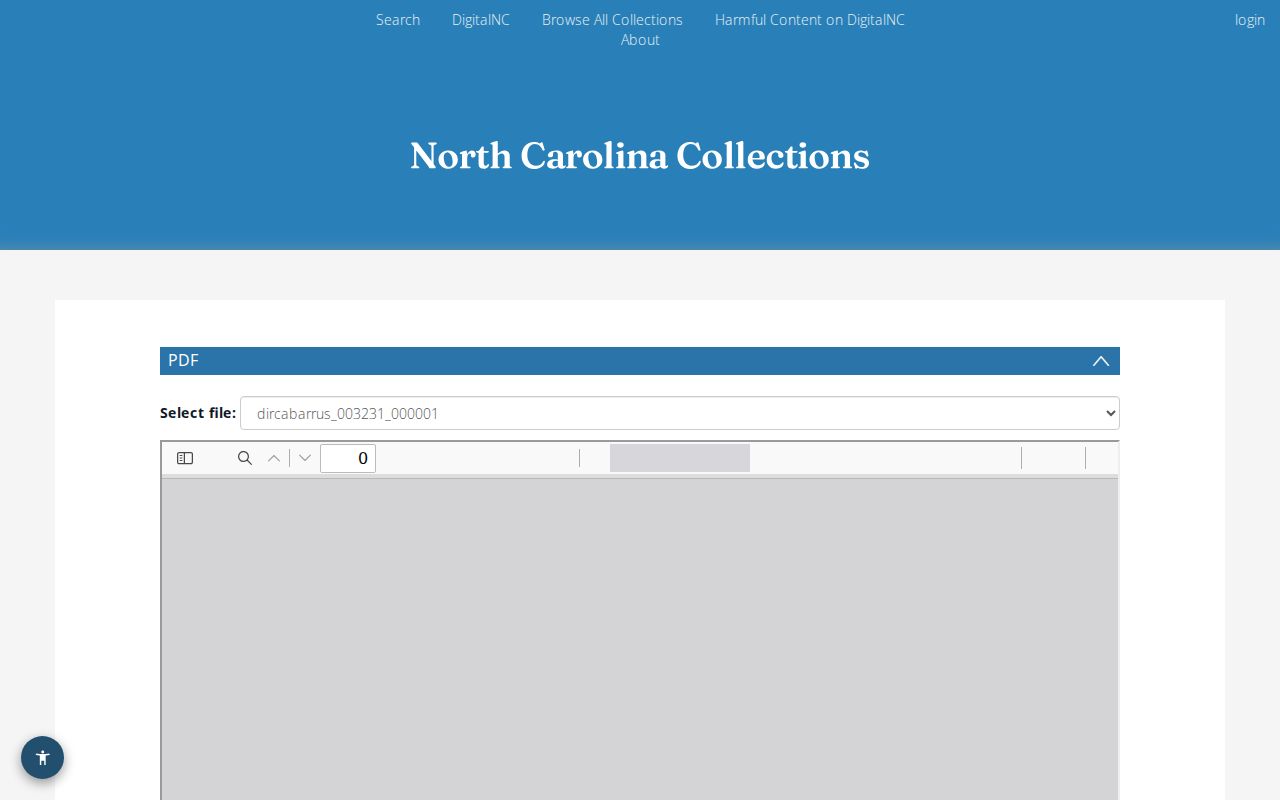
The record provides a direct path to page images, which should be checked whenever OCR changes a surname, initial, or street abbreviation.
Concord's early record geography centers on the county seat and Union Street. The city's name reflects the compromise over the county-seat location, and Union Street was named for that agreement. That history helps explain why old directory locations often cluster around the courthouse-centered street grid rather than a later postal pattern.
Baldwin Concord Directory Numbers
The 1942 Baldwin Master Edition is a useful bibliographic lead, not a fully verified online collection record. The research located its publisher, volume, length, and stated contents: an alphabetical directory of residents age 16 and over, a numerical householders and street guide, a classified business directory, civic material, and telephone or rural-route sections. Confirm the volume and its details against a library-held scan before relying on a citation from it.
The 1946 Baldwin PDF is a separately digitized source. Its publisher chart gives Greater Concord a January 5, 1946 figure of 26,656. That is a publisher-era service-area count, not a modern Census total and not a count of people inside the present city limits. It does, however, show the scale that the directory publisher claimed to serve.
Use Baldwin's numerical householder material for an address-first question, then compare the alphabetical listing. For a modern parcel or street search, use the Concord Street Directory records instead of treating a historical entry as current evidence.
Hill's Concord City Directories and Mill Names
Hill's 1949 Concord directory describes a coverage area that included Concord, rural routes, and nearby mills. The 1952 Hill directory, published by Hill Directory Co., Inc., names Brown Mill, Cannon Mill, Franklin Mill, Hartsell Mill, Jackson Park, Shankletown, Sidestown, Silver Hill, and rural routes from the Concord Post Office.
This is the collection's defining quirk. A household may be listed under one of those mill-community or rural-route labels rather than an address that looks like a current Concord neighborhood. Search each label as an alias, keep the wording found in the volume, and compare the page image with a later map or land record before trying to modernize the location.
The 1949 Hill profile reported a Greater Concord publisher estimate of 26,650. Along with the 1946 Baldwin figure, it shows a publisher-defined service area, not an interchangeable population series. Different editions should be read as separate snapshots.
Reading a Concord City Directory Entry
Directory entries pack many facts into a short line. In the 1946 Baldwin and 1952 Hill material, an entry can name the listed person, show a spouse in parentheses, identify children under the directory-listing age, give an occupation and affiliated organization, state a home address, and use compact household or widow marks. Historical publisher notation can also appear. Read the introductory key from the same volume rather than applying a meaning from another edition.
| Name | The indexed person, often with initials that need page-image verification. |
|---|---|
| Spouse or relationship | A name in parentheses may supply a relationship clue. |
| Occupation and affiliation | Work description and an associated organization when the publisher included them. |
| Address | House number and street, rural route, or mill-community location. |
| Household notation | The volume's h, r, and wid marks add context that must be read from its key. |
- Criss-cross section
- A street-order or numerical section that begins with an address and identifies a householder. Baldwin directories describe numerical householder and street-guide material.
- Householder index
- An address-focused list of household heads, useful for moving from a street number to a person before checking the alphabetical list.
- Abbreviation key
- The publisher's explanation of short forms. In these Concord volumes, h marks a householder or head of family, r identifies people in the home, and wid identifies a widow where known.
OCR is a finding aid, not a transcription. Scan errors can alter “Mc,” “O’,” directions such as N Union, and short codes. Cite the printed page after checking the image.
Concord City Directory Research at Lore Room
The Cabarrus County Library Local History Resources page identifies the Lore Room at the Concord branch as the local genealogy center. Its books, microfilm, and folders include material dating to 1750: deeds, wills, court minutes, marriage records, tax lists, estate papers, county censuses, newspapers, and the Lore Files. The page does not provide a complete city-directory shelf list, so call before a visit to ask about the exact year, a reverse directory, or an obituary file.
The official Lore Room source is shown below.
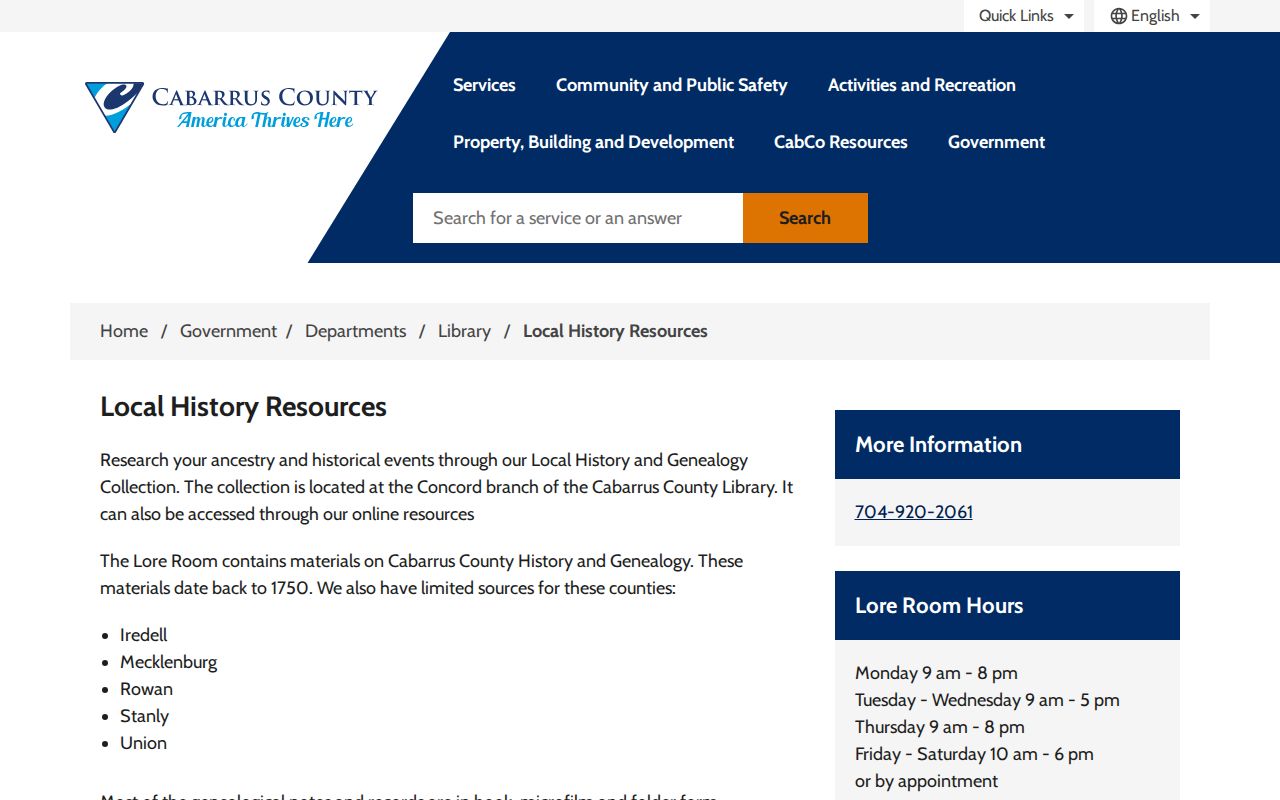
The Concord branch offers an in-person path when a directory volume is not available online.
Hours are Monday 9 a.m. to 8 p.m.; Tuesday and Wednesday 9 a.m. to 5 p.m.; Thursday 9 a.m. to 8 p.m.; and Friday and Saturday 10 a.m. to 6 p.m., with appointments available. Call the Lore Room at 704-920-2061 to ask staff to pull a directory or file. Search the library catalog first, then use the room for microfilm and folders; the catalog's digitized sources and the state archives are useful next stops when the shelf search runs out.
Concord Directory Evidence Beyond Volumes
A directory entry becomes much stronger when another local source supports it. The Lore Files collected by Adelaide and Eugenia Lore include area church records, family Bible records, and cemetery readings. The local history collection also identifies the Daily Independent, Concord Tribune, and Independent Tribune. A newspaper notice, cemetery reading, deed, or probate file can distinguish a person with a repeated name from someone else in the same directory.
Historic Cabarrus Association publications add compiled 1850 census work, family histories, and Grave Sights cemetery volumes, including West Concord Cemetery. They are secondary indexes, so use a volume and page as a lead to an original deed, certificate, obituary, or grave record.
Historic Cabarrus publications offer one local companion shelf for directory research.
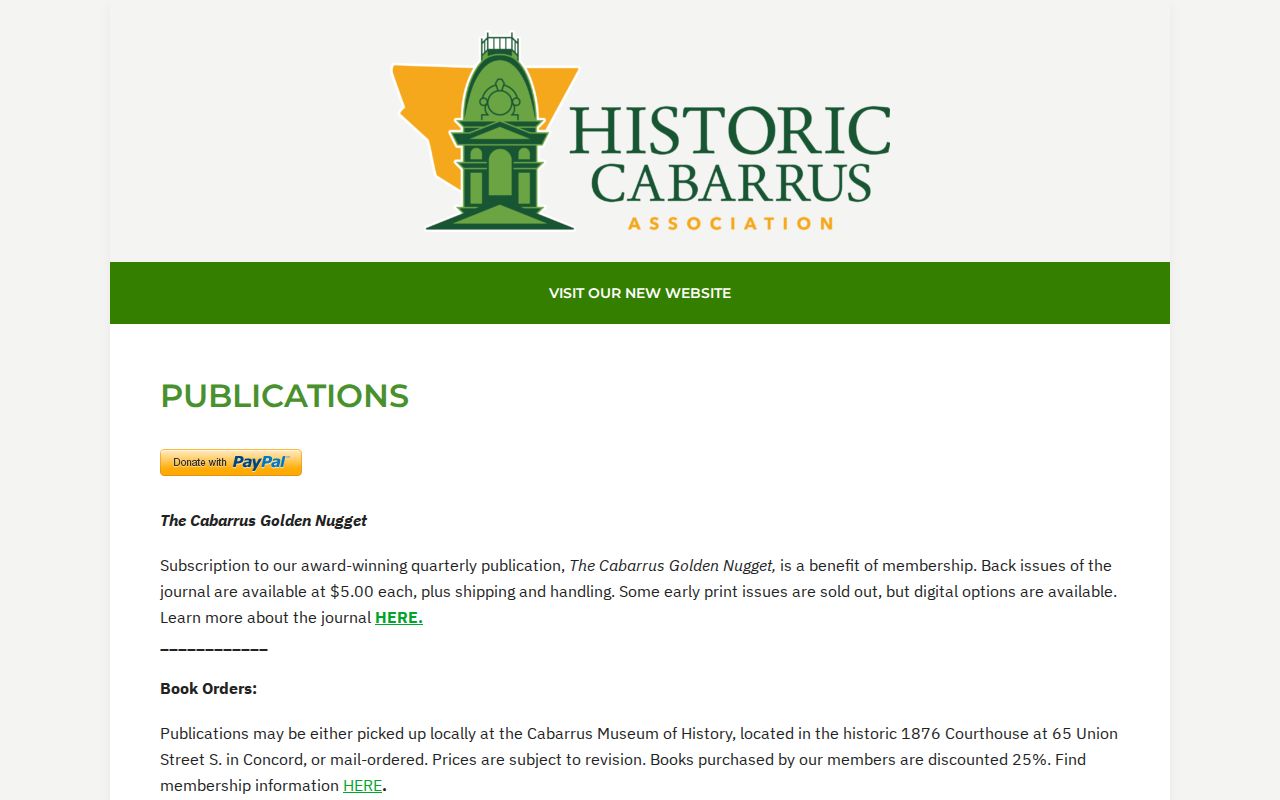
Pairing a directory's date and address with a cited compiled source creates a more defensible path to a primary record.
Trace Concord City Directory Households
Follow one household in date order, not by collecting every similarly spelled name. A move, an altered initial, or a changed community label can be meaningful, but it can also identify a different person. The route below uses each Concord city directory as a dated clue and lets the original page remain the citation point.
- Find the first plausible alphabetical entry and save its exact spelling, address, household marks, and page number.
- Check the same year's numerical or street-guide material when available. Record nearby numbers, but do not assume they identify a family relationship.
- Move to the next located year and compare address, spouse, occupation, community label, and initials. Note a disappearance without assigning a cause.
- Pair the directory sequence with the relevant census year, then use a deed, obituary, probate file, or cemetery source for a separate confirmation.
- When an address becomes the question, hand the current-record portion to the Concord Street Directory workflow rather than projecting an old entry into the present.
The identified run provides a compact research timeline: 1902 Inter-State; 1942 and 1946 Baldwin leads; 1949 and 1952 Hill editions; later located Hill entries for 1953, 1955, 1959, 1962, and 1963-64; plus a 1957 telephone directory lead. It is not a complete publication chronology. Missing years should be checked with the Lore Room or catalog before a negative conclusion is made.
Note: A directory's absence of a name can reflect timing, canvass limits, OCR, a changed listing form, or a move, so it should be corroborated rather than treated as proof.